

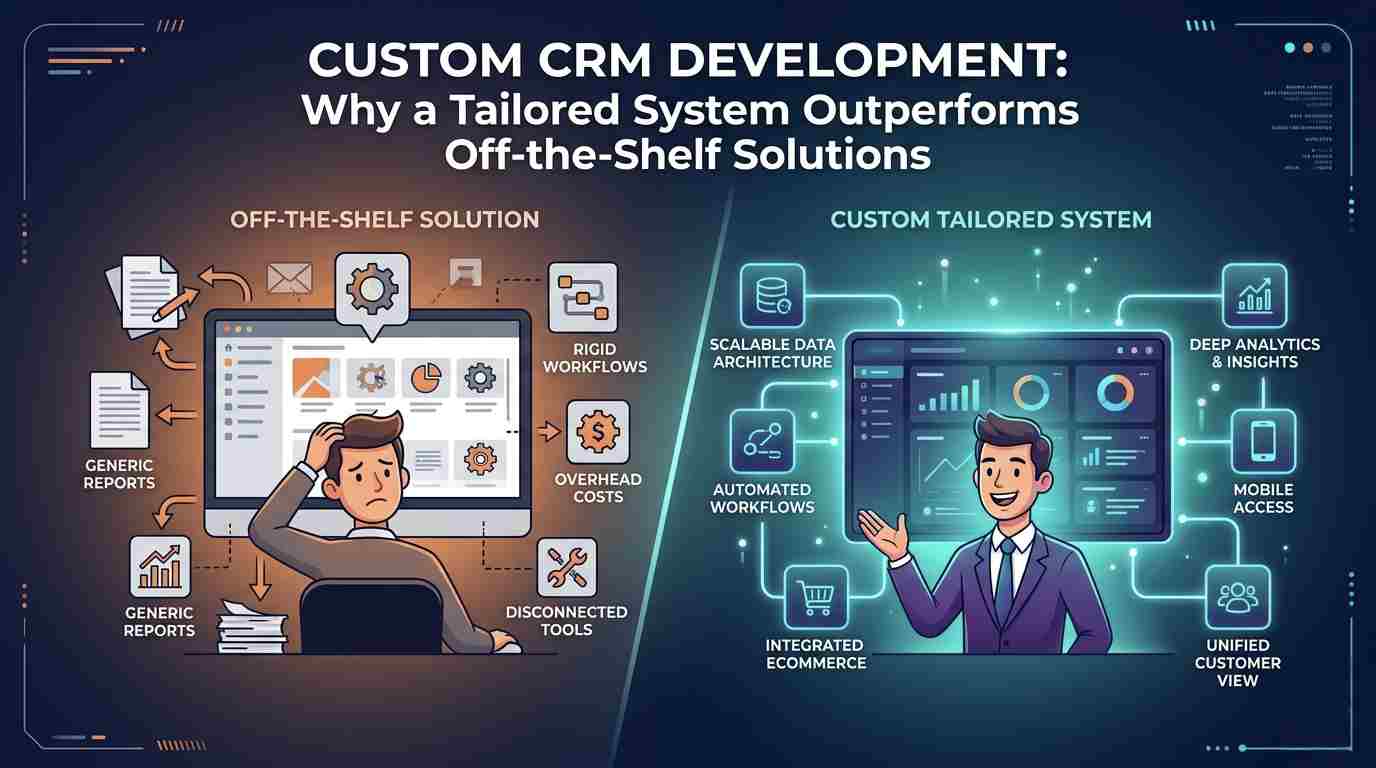
Customer relationships are the lifeblood of any business, and the tools used to manage them have a direct impact on growth, efficiency, and retention. While packaged CRM platforms dominate the market, a growing number of companies are discovering that generic solutions come with trade-offs that become increasingly costly as the business scales. Processes get bent to fit the software rather than the other way around, integrations break down, and licensing fees climb as the team grows.
What Custom CRM Development Actually Means
Investing in professional custom CRM development means building a system from the ground up — or significantly extending an existing platform — to match the exact way your business operates. Instead of adapting your sales pipeline, support workflows, or reporting structure to the constraints of a pre-built product, a custom CRM is designed around your processes, your data model, and your team’s specific needs. The result is a tool that fits naturally into daily operations rather than adding friction to them.
This approach is not limited to large enterprises. Mid-sized companies with complex sales cycles, niche industries with specialized workflows, and fast-growing startups that need a system that scales with them are all strong candidates for custom development. The question is not whether your business is big enough for a custom CRM — it is whether the gap between what off-the-shelf software offers and what your business actually needs is wide enough to justify the investment.
Custom vs. Out-of-the-Box: Where the Real Differences Lie
Off-the-shelf CRMs are built for the broadest possible audience, which means they include features most companies never use and lack features specific businesses genuinely need. Customization options exist, but they are bounded by what the platform’s architecture allows. A custom-built system, by contrast, has no such ceiling. Every module, workflow, automation rule, and data field is built specifically for your use case. And unlike a SaaS subscription where a vendor can change pricing, discontinue features, or sunset the product entirely, a custom CRM is an asset your business owns outright.
Core Features That Define a Well-Built Custom CRM
The feature set of a custom CRM should be driven entirely by the needs of the business commissioning it. That said, certain capabilities consistently appear in well-executed implementations across industries:
- Contact and account management — a centralized, searchable database of customers, leads, and partners with customizable data fields, relationship mapping, and full interaction history.
- Sales pipeline management — visual, configurable pipelines that reflect your actual sales stages, with automated reminders, task assignments, and deal progression tracking.
- Workflow automation — rules-based automation that handles repetitive tasks such as follow-up emails, lead routing, status updates, and internal notifications without manual intervention.
- Reporting and analytics — custom dashboards and reports built around the KPIs that matter to your business, rather than the metrics a vendor decided to include by default.
- Third-party integrations — seamless connections with your existing stack, including ERP systems, marketing platforms, accounting software, communication tools, and any proprietary internal systems.
The Role of Integrations in CRM Effectiveness
A CRM that sits in isolation from the rest of a company’s technology stack quickly becomes a burden rather than an asset. Data has to be entered manually in multiple places, information falls out of sync, and teams lose trust in the system’s accuracy. A well-built custom CRM is designed with integration as a first-class concern — connecting to email clients, calendars, telephony systems, e-commerce platforms, and whatever other tools your team relies on. When data flows automatically between systems, the CRM becomes the single source of truth for customer information rather than just another silo.
The Custom CRM Development Process
Building a CRM that genuinely serves the business requires a structured development process that starts long before any code is written. Understanding this process helps set realistic expectations and ensures the final product reflects actual business needs rather than assumptions made at the outset.
Discovery and Requirements Definition
The most valuable phase of custom CRM development is often the least visible: the deep discovery work that maps out how the business actually operates. This involves interviews with sales teams, customer support staff, operations managers, and executives to understand current workflows, pain points, data requirements, and integration dependencies. A thorough discovery phase surfaces requirements that stakeholders may not have articulated explicitly — and prevents costly rework later. The output is a detailed specification that serves as the blueprint for everything that follows.
Architecture, Development, and Quality Assurance
With a clear specification in place, the development team designs the system architecture — the data model, API structure, user roles and permissions, and the technical framework that will underpin the entire platform. Development typically follows an iterative approach, with working modules delivered and reviewed in stages rather than all at once. This allows the business to validate that the system behaves as expected and to refine requirements based on hands-on experience with early builds. Rigorous quality assurance testing — covering functionality, performance under load, security, and cross-browser or cross-device compatibility — ensures the system is production-ready before launch.
Total Cost of Ownership: Custom vs. Licensed Software
The upfront cost of custom CRM development is higher than purchasing a subscription to an existing platform, and it is important to be clear-eyed about that. However, a full cost comparison over a three-to-five-year horizon often tells a different story. SaaS CRM pricing is typically per user per month, meaning costs grow linearly with headcount. Enterprise tiers with advanced features, custom reporting, or API access can push annual licensing costs into six figures for mid-sized organizations. A custom system, once built, has no per-user fees and no vendor lock-in — the ongoing costs are limited to hosting, maintenance, and any future enhancements.
There is also the cost of compromise to consider. When a business forces its processes to conform to the limitations of an off-the-shelf product, the efficiency loss is real but often difficult to quantify. Workarounds, manual data entry, disconnected systems, and staff frustration all represent a cost — one that does not appear on a software invoice but accumulates steadily over time.
When Custom CRM Development Is the Right Choice
Custom development is not the right answer for every organization. For a small team with straightforward sales processes and standard reporting needs, a well-configured off-the-shelf CRM may be perfectly adequate. The case for custom development strengthens when a business has complex, highly specific workflows that packaged software cannot accommodate; when deep integration with proprietary or industry-specific systems is required; when data ownership, privacy, or regulatory compliance demands full control over the infrastructure; or when the long-term cost of licensing and the limitations of a third-party platform outweigh the investment in building something purpose-built.
The companies that benefit most from custom CRM development are those that recognize their customer management processes as a genuine competitive advantage — and understand that a generic tool is unlikely to support or enhance that advantage over the long term. A system built specifically for your business, by a development partner who takes the time to understand how you operate, becomes a platform that grows with you rather than one you eventually outgrow.