

The Australian legal landscape is a sophisticated blend of common law traditions and a robust statutory framework. For law students and junior practitioners, the ability to navigate this system is not just an academic requirement—it is the bedrock of professional competence. Whether you are tackling a complex problem question on constitutional validity or drafting a submission for the Administrative Appeals Tribunal (AAT), your success hinges on two core pillars: exhaustive research and precise writing.
In Australia, the law is never static. With the High Court frequently refining judicial precedents and Commonwealth and State parliaments passing a high volume of legislation, staying updated is a constant challenge. Mastering these skills requires a disciplined approach, an understanding of the hierarchy of authority, and the technical ability to use modern legal databases effectively.
The Foundations of Australian Legal Research
Effective research begins with understanding where the law comes from. In the Australian jurisdiction, you must distinguish between primary sources (legislation and case law) and secondary sources (textbooks, journal articles, and legal encyclopedias).
When students feel overwhelmed by the sheer volume of judicial commentary, seeking specialized administrative law assignment help can provide the necessary clarity to distinguish between binding and persuasive authorities.
1. Navigating Legislation
Legislation (Acts of Parliament) is the supreme source of law in Australia. To research effectively, you must ensure the Act is “in force” and check for recent amendments.
- Federal Legislation: Use Federal Register of Legislation for Commonwealth Acts.
- State Legislation: Use platforms like NSW Legislation or Victorian Legislation for state-specific matters.
- Delegated Legislation: Don’t forget regulations, ordinances, and legislative instruments, which often contain the procedural “meat” of the law.
2. Mastering Case Law and the Doctrine of Precedent
The doctrine of stare decisis dictates that lower courts must follow the decisions of higher courts within the same hierarchy.
- Authorized Reports: Always cite the authorized version of a case if available (e.g., Commonwealth Law Reports (CLR) for the High Court).
- Medium Neutral Citations: Understand how to read citations like Minister for Immigration and Border Protection v SZVFW [2018] HCA 30.
Strategic Legal Writing: The IRAC Method
Writing in the Australian legal sector demands a “plain English” approach. The goal is not to sound “lawyerly” with archaic Latin phrases, but to be clear, concise, and persuasive. The most effective framework for legal problem-solving remains the IRAC method:
- Issue: Identify the specific legal question.
- Rule: State the relevant statutory provisions and case law.
- Application: Apply the law to the specific facts of the case (this is where the most marks are earned).
- Conclusion: Provide a definitive answer based on your analysis.
For comprehensive support across various legal units, professional assignment help ensures that your IRAC structures meet the rigorous standards expected by Australian universities and the Legal Profession Admission Board (LPAB).
Data-Driven Insights: The Importance of Legal Tech
According to the 2024 Legal Technology Survey Report, over 75% of legal professionals in Australia now utilize AI-integrated research tools like Lexis+ or Westlaw Precision to reduce research time. However, the importance of “human-in-the-loop” remains critical. Relying solely on AI can lead to “hallucinations” of non-existent cases—a mistake that can be fatal in both academic and professional settings.
Key Takeaways for Success
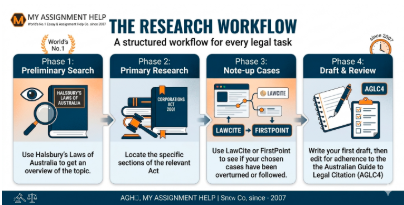
- Prioritize AGLC4: Accuracy in referencing is non-negotiable in Australia. Even a brilliant argument can be undermined by poor footnoting.
- Use Secondary Sources First: Don’t dive straight into the High Court cases. Read a textbook chapter to understand the context first.
- Verify Currency: Always check the “currency” of a statute. An amended section can change the entire outcome of your legal advice.
- Clarity over Complexity: Use short sentences. The best legal writing is accessible to a layperson while remaining technically accurate.
Frequently Asked Questions (FAQs)
Q1: What is the most reliable database for Australian case law?
A: While AustLII is excellent for free access, subscription services like Westlaw Australia and LexisNexis provide “authorized” reports and citators that are essential for deep research.
Q2: Why is AGLC4 so important?
A: The Australian Guide to Legal Citation (4th ed) is the uniform standard across Australian law schools and courts. Consistency in citation ensures that readers can verify your sources immediately.
Q3: How do I handle conflicting precedents?
A: Look at the court hierarchy. A decision from the Full Bench of the Federal Court will generally carry more weight than a single judge’s decision in a State Supreme Court on federal matters.
References
- Australian Guide to Legal Citation (4th ed, 2018).
- Cook, C. et al., Laying Down the Law (LexisNexis, 11th ed, 2021).
- High Court of Australia, Annual Report 2024-2025.
- Rule of Law Institute of Australia, The Australian Legal System Overview.
Author Profile: Sarah Jenkins
Senior Legal Consultant at MyAssignmentHelp
Sarah Jenkins holds an LLM from the University of Sydney and has over a decade of experience in academic legal writing and SEO content strategy. Specializing in Australian Administrative and Constitutional law, Sarah has helped thousands of students navigate the complexities of the AQF (Australian Qualifications Framework) standards. At MyAssignmentHelp, she ensures that all legal content adheres to strict E-E-A-T principles, providing students with authoritative and trustworthy guidance for their academic journeys.